The most influential person in any organization is rarely the most senior. This is not a romanticization of informal leadership. It is an observable and documented feature of how organizations actually work — one that most leadership development frameworks studiously avoid examining, because it carries an uncomfortable implication: that the authority structure on the organizational chart and the influence structure that actually moves decisions are frequently two different things.
Leaders who understand this live and operate differently. Leaders who do not spend careers wondering why their formal power produces less movement than they expect.
Authority and Influence: A Necessary Distinction
Authority is positional. It derives from role, title, and the formal structures of organizational hierarchy. It carries legitimate power in the Weberian sense — the socially recognized right to direct, evaluate, and allocate resources within a defined domain. Authority is assigned. It can also be rescinded, reorganized, and circumvented.
Influence is relational and reputational. It derives from the credibility, trust, and social capital an individual accumulates through their interactions, decisions, and track record over time. Unlike authority, influence is not conferred by the organization — it is earned through the judgments others make about whether your thinking, your advocacy, and your perspective are worth incorporating into their own decision-making.
These two things can and do coexist. But they are not the same mechanism, and treating them as interchangeable is a significant and common leadership error. Authority compels. Influence persuades. Authority produces compliance. Influence produces commitment. And in any organization doing work that requires genuine intellectual engagement, creativity, or complex coordination — which is nearly every organization worth examining — commitment produces meaningfully better outcomes than compliance.
The Social Capital Underneath Organizational Power
Pierre Bourdieu’s theory of social capital identifies networks of durable relationships — and the resources embedded within them — as a form of capital that operates in parallel with economic and cultural capital. In organizational contexts, this translates to something specific and measurable: the accumulated reservoir of trust, goodwill, and reciprocal obligation that a leader builds through their relationships over time.
Ronald Burt’s extension of this framework into organizational network theory adds a critical spatial dimension. Burt’s research on structural holes — the gaps between different clusters of people and information within organizations — found that individuals who bridge those gaps accumulate disproportionate influence relative to their formal position. They do so not through dominance but through information brokerage: they have access to perspectives, data, and relationships that others do not, and they use that access to create value in ways that make them indispensable.
This is influence without authority in its most powerful form. The broker does not command anyone. They do not need to. They have become the connective tissue through which the organization thinks.
A director of strategy at a large financial services organization — three levels below the C-suite — held more genuine organizational influence than several of the executives above her. She had spent five years building trusted relationships with leaders across every major business unit, consistently providing insight that helped each of them think more clearly about their own domain. She was not promoting herself. She was making herself structurally necessary. When the CEO needed a real picture of organizational dynamics before a significant restructuring, she was the first person consulted. Not because of her title. Because of her network and her judgment.
How Organizational Power Actually Moves
Power in organizations moves through three channels that formal hierarchy does not capture and that leadership development rarely teaches directly.
Information control. Those who shape what information reaches decision-makers, how it is framed, and what context accompanies it hold substantial power regardless of their formal position. This is not manipulation — it is the natural consequence of organizational complexity. Every leader depends on others to filter, interpret, and present information. The people they trust to do this well accumulate influence in proportion to the quality of their judgment.
Coalition building. Major organizational decisions — strategy shifts, resource allocations, culture change initiatives — do not move through formal authority alone. They move when enough of the right people are aligned. The leader who builds coalitions before the formal decision-making moment — who has already secured the understanding, if not the explicit support, of the key stakeholders — shapes outcomes from a position of structural advantage. Jeffrey Pfeffer’s research on organizational power at Stanford identifies coalition building as perhaps the single most reliable predictor of sustained organizational influence.
Narrative control. Organizations are meaning-making systems. The leaders who shape how events are interpreted — who provide the framework through which others understand what is happening, why it matters, and what it requires — exercise a form of influence that is frequently more durable than any individual decision. This is not spin. It is the leadership of context, and it is a skill that formal authority does not automatically confer.
Why Senior Leaders Lose Influence Despite Having Authority
One of the more counterintuitive findings in organizational power research is that formal authority, used too aggressively or too exclusively, tends to erode informal influence over time. Pfeffer describes this as the power paradox — the irony that the people who most visibly exercise authority are often the ones whose actual influence is most fragile.
This happens for several reasons. Leaders who rely heavily on positional power signal, implicitly, that they do not trust their ability to persuade — which is itself a credibility signal. They also tend to reduce the safety of honest disagreement, which means they receive worse information, make worse decisions, and gradually lose the intellectual credibility that is the foundation of durable influence. And they frequently mistake compliance for commitment, continuing to believe they are moving the organization in ways that their direct reports have already learned to route around.
A chief operating officer I worked with had spent a decade building what he described as “a high-accountability culture.” What he had actually built, as his team described it privately, was an environment in which people had become highly skilled at managing his perceptions. They brought him the information he wanted to see. They agreed with his framing in meetings. They waited him out. His authority was intact. His influence had collapsed entirely.
Three Frameworks for Building Influence Without Relying on Position
Framework One: The Credibility Investment Map
Identify the five relationships in your organization through which your most important priorities must travel in order to move. For each relationship, honestly assess: does this person trust my judgment independent of my title? Have I demonstrated value to them in ways that have nothing to do with my formal authority? Have I advocated for their interests when they were not in the room? These five relationships are your credibility infrastructure. Investment in them is not relationship management for its own sake — it is the construction of the channels through which your influence actually operates.
Framework Two: The Information Value Audit
For the past three months, trace the most important pieces of insight, perspective, or analysis you have offered to senior leaders or key stakeholders. What was the source? Was it synthesized from your own network and judgment, or was it largely information that others with your title would have had access to? The leaders with genuine organizational influence are consistently bringing perspectives that are not easily replicated — insight derived from the quality of their relationships, the diversity of their networks, and the distinctive way they connect information across domains.
Framework Three: The Influence Horizon Test
Genuine influence operates over time horizons longer than any individual interaction. Ask: what decisions made in the last year reflect my thinking, my values, or my framing — in conversations I was not part of? If the answer is few, you may have authority. You may even have visibility. But you have not yet built the kind of influence that operates independently of your presence. Closing that gap requires a deliberate shift from acquiring positional power to building reputational capital — one investment, one honest conversation, and one moment of trustworthy judgment at a time.
Influence in the Age of Remote Work and Distributed Organizations
The conditions of distributed and hybrid work have restructured the influence landscape in ways that are still not fully understood. The informal mechanisms through which organizational influence historically built — hallway conversations, observed behavior, proximity to decision-makers — have been significantly disrupted. What has replaced them is a combination of digital communication and formal meeting structures that tend to amplify positional authority at the expense of relational influence.
In this environment, the leaders who maintain and build genuine influence are those who are most intentional about the relational investments that distributed work makes harder: the one-on-one conversation that has no agenda, the proactive share of information that has no immediate self-interest, the advocacy for a colleague’s work in a meeting they did not attend. These are small acts. They are the substance of social capital. And in a distributed organization, they require more deliberate effort than they did when proximity did some of the work automatically.
A Final Word
The leaders who have built the most enduring organizational influence — who shape decisions and directions long after their formal authority over a domain has ended, who are sought out across career transitions and organizational changes — have one thing in common: they invested in their credibility when it was not required and their reputation when no one was keeping score.
Influence without authority is not a workaround for leaders who lack power. It is the most sophisticated form of leadership power available — the kind that does not depend on an organizational chart remaining unchanged, that persists through restructuring and regime change, and that derives its durability from the one source no organization can revoke: the genuine trust of the people you have consistently chosen to serve well.
That kind of influence is not claimed. It is earned, slowly and without announcement, in the decisions that reveal what you actually value when the cost of your values is real.
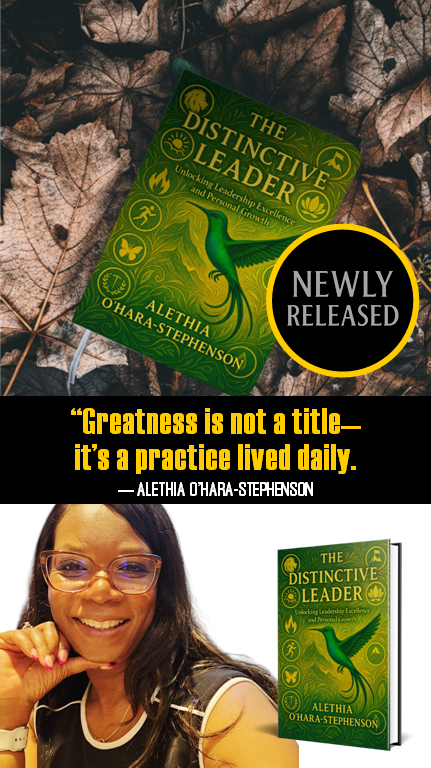
Alethia O’Hara-Stephenson is a leadership strategist, executive advisor, and author of The Distinctive Leader. She works with senior executive teams and speaks at leadership conferences and organizational forums on influence, leadership identity, and the dynamics of organizational power.
